
Skin Care and Preventative Therapies
Skin Care and Preventative Therapies
Prevention of skin breakdown is vital. Relieving pressure by shifting your child’s body weight frequently, along with proper skin care, can help prevent pressure sores from developing. Ways to prevent skin breakdown must become part of your child’s daily routine, just like brushing teeth.
(Consult your medical team for specific guidelines related to your skin care.)
- Ensure your child does complete pressure releases every 15 minutes. This takes pressure off your child’s tailbone and other bones they sit or lie on. Your therapy team will teach you the best release techniques for your child.
- Keep your child’s clothes, wheelchair covers, and bed linens clean and dry. Change them as soon as possible if they are soiled.
- Apply lotion on your child’s skin to prevent dryness.
- Protect your child’s bony areas from pressure.
- Elevate your child’s legs when they’re lying down so that their heels are lifted from the surface. A pillow, towel roll or rolled blanket can be used under the lower legs to keep their heels off the surface.
- Make sure your child wears the recommended footwear, splints, braces, stockings, etc.
- Use the appropriate cushions, special mattresses, and padding on your child’s bed.
- Avoid using donut-type devices, which may increase pressure in some areas.
- Avoid tight-fitting clothes and shoes; appropriately sized shoes may help protect your child’s skin from injury.
- Avoid wrinkles and thick seams in your child’s linens and clothes that may cause rubbing against the skin.
- Avoid friction when moving your child across a surface. Friction can damage the skin, much like sandpaper would.
- Take measures to prevent your child from sliding down in their wheelchair or in bed. This causes shearing, which is when two layers of skin are pulled in opposite directions. It can lead to skin breakdown and increase the risk of pressure sores.
- When your child is sitting in a chair, shift their weight at least every 15 to 30 minutes.
- Your therapy team will use a tool called a pressure map to determine the best seating and positioning for prevention of skin breakdown.
Check List for Your Child’s Skin
- Check your child’s skin for any of the signs of pressure sores — especially over the bony areas and in skin folds.
- Skin should be checked at least every four hours or after transferring your child from wheelchair to bed.
- Feet should be checked before and after wearing shoes, stockings, splints/braces.
- Use a long-handled mirror to check areas not easily visible, especially if your child is checking themselves.
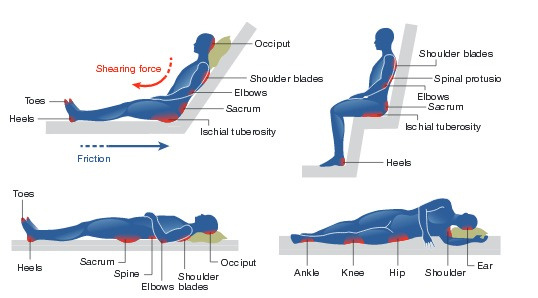
The red areas in the illustration below show common areas where pressure sores can develop. Please discuss these with your care team to learn about pressure relief techniques for these areas.
- Skin redness or color change lasts more than 30 minutes after changing positions.
- You notice new signs of skin irritation such as rashes, sores, blisters, or bruises.
- You have questions or concerns about skin care and treatment.
- Make sure your child eats a healthy diet and drinks plenty of fluids. Good nutrition helps keep skin healthy.
- Avoid caffeine, smoking, vaping, alcohol and recreational drugs, which can decrease circulation to the skin and increase the risk of skin problems.
Upper Extremity Care
Your child should perform regular upper extremity stretching daily. Your child’s therapist will customize a stretching program based on your child’s individual needs and can teach you how to help your child with the stretches. The program may include neck, shoulder, and arm stretches.
Wheelchair:
As an inpatient at Ranken Jordan, your child will use a wheelchair to promote mobility, which is an important part of recovery. The loaner wheelchair will be modified to best fit your child and you will receive education about how to best position your child in the wheelchair to reduce the risk of injury. If needed, we will provide a wheelchair evaluation before you go home so your child can get a custom wheelchair for use in your home and community.
Positioning in Bed:
If your child has decreased upper extremity active movement, supporting their arms and shoulders with pillows while in bed can improve their comfort and reduce the risk of upper extremity injury. While your child is an inpatient at Ranken Jordan, the therapy team, physiatry team, and medical team will make recommendations on positioning your child in bed to further reduce injury risk.
“I still think about how Ranken Jordan changed my life.”
— Kiland Sampa, Inpatient Jul-Nov 2013, Outpatient Dec 2013-Dec 2014